Lots in, outcomes back. Two applications, one PC, nothing sent anywhere.
LotWarden knows which reagent, calibrator and control lots were in use on any day. EQAWarden knows how every EQA result performed. Linked on one computer, each answers the other's question: which lot was on board when this result was analysed, and how did results behave on that lot.
LotWarden supplies facts. EQAWarden owns the interpretation.
Two separate applications on one PC, each with its own records, its own audit chain and its own port. Nothing is ever written across.
 127.0.0.1:5759
- Products, lots, dates in use, expiry from the Date in Use section and the controlled logs.
- Lot intervals with a confidence. A lot runs from its date in use to the next lot of the same product. Each link is rated high, medium or low, and the basis is stated.
- A snapshot with a hash. Every interval carries the SHA-256 of the lot-usage snapshot it was derived from.
 127.0.0.1:5760
- Results and outcomes per lot. Every EQA result with the reagent, calibrator and control lots on its analysis date, its APS score and whether it was within the APS.
- A lot summary. Results per lot, how many were outside the APS, the mean deviation and the shift against the previous lot.
- Keyed with LotWarden's own lot ids, so LotWarden reads the outcomes straight into its lot history and its assessment pack.
Off by default, on both sides
The link is switched on deliberately, with initials, and the switch is written to the audit log. While it is off, neither application calls the other. A copy that has no link set up says so.
Loopback only
Both applications refuse every connection that is not from this PC. The link adds the Host-header and origin checks that guard every other request, so a page in another tab, or another machine, cannot use it.
File fallback
Running on different PCs, or with the link off? LotWarden's lot-usage export or EQAWarden's evidence export can be carried across instead. Each file carries a SHA-256 that is checked on import.
Read-only in both directions. EQAWarden never writes to LotWarden's records, and LotWarden never writes to EQAWarden's. Each keeps what it read, with the hash of what it read, in its own sealed store.
The lot change is on the chart before anyone asks.
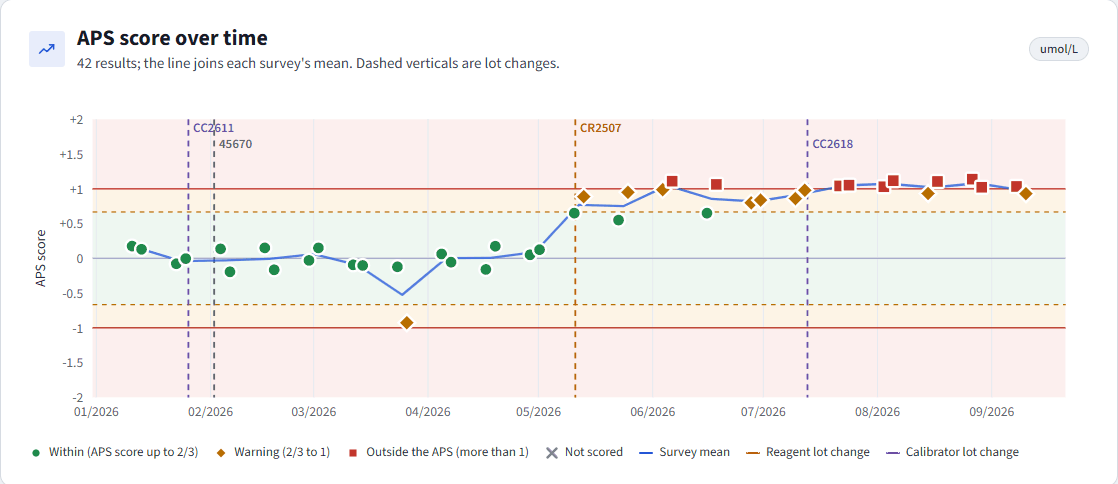
- Dashed lines at every lot change on the APS score chart, reagent and calibrator alike.
- A step test at each change. Results before against results after, with a permutation test and the confidence of the lot link.
- The lots on the analysis date, for every result in the assessment, with the primary and possible lots when a changeover fell close to the run.
- Internal QC before and after, on the same control lot, so a reagent lot effect and a calibration effect can be told apart.
The result is a cause the reviewer can check in minutes rather than reconstruct from the logs: "results moved after the reagent lot changed on this date, and internal QC moved the same way".
Records an assessor can follow from the docket to the signed review.
ISO 15189:2022 asks a laboratory to record the reception of its reagents (clause 6.6), to run internal quality control (7.3.7.2) and to take part in and act on external quality assessment (7.3.7.3). The two applications keep those records joined.
Survey record
Every result, its score, its lots and its IQC status, with the reviewer's outcome, cause, conclusion and initials. Exported per survey as a workbook.
Cycle summary and evidence workbooks
Performance across the cycle, reviews open and closed, days to review, and the corrective actions taken, in the form an assessor asks for.
EQA by lot in the assessment pack
LotWarden's assessment pack gains an EQA by lot sheet and a checklist item under 7.3.7.3 for the quality manager to confirm, so lot acceptance and EQA performance sit in one pack.
Built on the same foundations, so IT approves it once.
EQAWarden reuses LotWarden's platform code unchanged where it can: the network guard, the hash-chained audit log, the request guards, the sealed store and the single-folder deployment. The ten-minute checklist applies to both.
| LotWarden | EQAWarden | |
|---|---|---|
| Job | Goods receiving, lot acceptance, the controlled logs | EQA review, interpretation, the signed review record |
| Reads | Scanned delivery notes, the PAT register, the department's logs | myQAP survey reports, results files, Unity Real Time exports, LotWarden lots |
| Writes | The laboratory's own workbooks, through Excel, after a backup | Its own sealed store and exports only; never another system |
| Address | 127.0.0.1:5759 | 127.0.0.1:5760 |
| Network | Loopback only, enforced at socket level; every blocked attempt logged | |
| Audit | SHA-256 hash-chained audit.log and network_audit.log, verified on every start | |
| At rest | Encrypted; the key stays beside the app | |
| Deployment | One folder on a Windows PC; no installer, services, scheduled tasks, registry writes or admin rights | |
| Validation | Fictional fixtures, golden scenarios, versioned sections, a validation dossier per release | |
One walkthrough, both applications.
We receive a delivery in LotWarden, switch the link on with initials, and open the EQA assessment that names the lot. Twenty minutes on a video call, wherever you are.